Sabtu, 03 Mei 2014

Budget and ICAC cost Abbott the high ground

Laura Tingle  PUBLISHED: 02 May 2014

Budget and ICAC cost Abbott the high ground

Abbott has become a victim of his own excessive attack on Labor. Photo: Penny Stephens

The modus operandi of conservative politics in recent years has been simple but deadly: attack, attack and attack.

Attack Labor for being economically and administratively incompetent; attack Labor for breaking election promises (well, one); attack Labor for being rotten to the core, if not corrupt, as a result of its links with the trade union movement.

Labor has so often made the job easy: unable to authoritatively articulate and deliver an economic strategy; failing to properly implement thought-bubble policy changes and, particularly in NSW, providing a never-ending stench of shady deals and improper influence.

There wasn’t much positive on offer from the Coalition except simple pledges to be better than Labor, to actually honour promises in order to restore faith in the politics that their tactics had helped to tear down, and to cut taxes.

But the last couple of weeks have seen one of those shifts in the political tectonic plates – a long time in the making, but violent enough to make even those with one set of rules for Labor but another for the Coalition – sit up and take notice.

The chaotic messages from the Abbott government on its budget strategy, combined with devastating evidence from the Independent Commission Against Corruption in NSW about Liberal Party slush funds – not 30 years ago but in the here and now – has robbed the Coalition of the high ground it claimed on both economic management and probity.

Labor and its federal leader still have to drag themselves back on to the charts of political contestability with voters.

But the combined shocks of the unravelling of the clothes of Emperor Abbott and his party on both budget management and political probity will have inevitable repercussions on the way politics plays out long into the future.

The impact of ICAC revelations about Liberal Party donation dealings has already been profound. Even Labor people had come to believe that the stench of corruption in NSW was something that only applied to it.

As grubby as each other

It may not be all that edifying for the rest of us to see that both sides of politics are as grubby as each other. But it has had a curiously restorative fact on those in Labor ranks who have felt nothing but shame as tawdry stories about Eddie Obeid and his ilk have pumped out of the ICAC.

Meanwhile, even before we view the first Hockey budget, we know enough to see the infallibility of a still new government’s political and economic strategy punctured. Pollsters report voters are “white hot” about the Coalition’s plan to raise taxes. The government backbench is besieged and angry and the media cheer squad is incandescent.

The senior ranks of the government just look shell-shocked. How could it be, they ask, that a leader who relentlessly said, “We are about getting rid of taxes, not imposing new taxes”, and whose only real pledge was to keep his promises, could possibly be contemplating a “debt tax”?

The damage to Abbott’s authority is revealed by the revolt in his own party over paid parental leave and his humiliating concession that, at the least, the income limit on the scheme will be cut back to $100,000.

It is also revealed by the open brawling with his senior ministers about how the debt tax is applied and even whether the government pursue another option.

The success of Tony Abbott’s relentless attack psyched out Labor long ago. His missteps on the budget will prompt the opposition to reassess.

Abbott has become a victim of his own excessive attack on Labor’s economic strategy and, ironically, a perpetrator of the same strategy.

Away from the outrage about a short-term debt tax, the government’s focus is on finding medium to long-term budget cuts.

For that is where the real problems lie, and not just because of Labor’s disability scheme and education reforms.

In fact, you may have noticed these barely rate a mention as the Coalition has made the case for big long-term cuts in entitlements. It has been areas like the age pension and health – recognised as the real danger areas by both sides for decades – that are the focus.

Big cuts and radical change

All the indications are that the budget will contain big cuts, and radical change, to many areas of spending, including universities and health.

Despite all the “budget crisis” hysteria, the deficit is forecast to wind back sharply from about 3 per cent of GDP to 1 per cent of GDP as a result of Labor cuts.

Abbott’s problem is his boasts about being better able to deliver a surplus faster.

That has left the government feeling compelled to produce an even faster turnaround in the bottom line, despite the warnings about the impact this might have on economic activity.

Hemmed in by his own rash promises to leave so much spending untouched, the Prime Minister has resorted to doing exactly what Labor did: pothole here and there on spending and resort to any revenue raising that can be found.

In fact, the Coalition strategy currently looks for all the world like the one Labor ran: a refusal to engage in deep cuts in the short term because of their economic impact; spending cuts constrained by politics forcing revenue hikes that are even more unpopular; longer-term spending cuts still swamped by exceptionally expensive policy initiatives. In Abbott’s case these are the paid parental leave scheme and his ludicrous Direct Action plan, which the government has not even funded beyond the current budget.

Even the Commission of Audit is suggesting an antidote that looks suspiciously like the one Labor struggled to apply: a 1.75 per cent cap on annual real growth in spending compared with Labor’s 2 per cent target.

The constraints that have forced the government to raise taxes and charges in the looming budget have also forced its hand on promising to outline tax cuts in its next term.

This is locking in the same sort of high- risk policy that has got us into this mess in the first place. We might all want tax reform and lower taxes but locking in expectations of compensatory tax cuts in a few years’ time is high folly when strong economic growth remains elusive and the existing revenue base weak.

It is not as if the government has any real political capital to burn on what was always going to be a very hard budget. It never had a honeymoon. Voters don’t like the Prime Minister.

The Coalition’s only real chance at pulling this off was to deliver a very tough budget that voters wouldn’t like but one that delivered a coherent story – both internally coherent and part of a story about the end of the age of entitlement.

Instead, the wheels of the budget are already looking very wobbly, with less than a fortnight to go until it is delivered.

Budget and ICAC cost Abbott the high ground

Jumat, 02 Mei 2014

Audit declares war on young Aussies

By Leith van Onselen Posted Fri 2 May 2014

Students could cop it Photo: The generation that received free university education has recommended decreasing Commonwealth grant scheme funding for higher education from 59 per cent to 45 per cent. (ABC News)

There is a nasty sting in the tale in the Commission of Audit's recommendations for younger generations, while baby boomers are largely insulated, writes Leith van Onselen.

The Commission of Audit (COA) report, released yesterday, contained a raft of recommendations, the centerpiece of which were sweeping changes to Australia's retirement system, including:

  • lowering the indexation rate of the aged pension to 28 per cent of average weekly earnings (from the current 28 per cent of male weekly earnings);
  • tightening means testing around the age pension, including capturing the value of one's principal place of residence above $500,000 for a single and $750,000 for a couple;
  • gradually increasing the aged pension access age to 70 by 2053;
  • increasing the superannuation preservation age to five years below the aged pension access age, so that by 2027 it would reach 62; and
  • restricting access to the Commonwealth Seniors Health Card by adding deemed income from tax-free superannuation to the definition of adjusted taxable income used for determining eligibility.

Taken at face value, the COA has produced a sensible set of recommendations that are similar to those espoused on my blog for the past year or so.

However, there is a nasty sting in the tale in the COA's recommendations that should anger Australia's younger generations, which is summarised in the below statement:

The Commission considers that people born before 1965 should not be subjected to this change or any other further changes to the eligibility age to ensure they have adequate time to plan for their retirement.

That's right, the COA panel - dominated by baby boomers - has conveniently chosen to spare its own generation from wearing any budget cuts. Meanwhile, the younger generations - "generations rent" - will be required to bear the full burden of adjustment while their relatively well-off parents continue to enjoy their full entitlements while living in their expensive homes.

Retirement policy isn't the only area where the COA places its crosshairs over the young. It has also recommended that the Government curb Newstart - already a measly $13,273 per year (versus about $20,000 for the single aged pension) - by forcing young singles without dependents aged 22 to 30 who have already been on benefits for 12 months to move to higher employment areas or lose their payments, as well as increasing the rate at which Newstart payments are decreased for extra income to 75 per cent.

It has also recommended slashing the minimum wage from 56 per cent of average weekly earnings to 44 per cent, as well as slashing family tax benefits, which could effectively lower families' disposable income by 10 per cent, according to COA modelling.

And of course, the generation that received free university education has recommended decreasing Commonwealth grant scheme funding for higher education from 59 per cent to 45 per cent and increasing the proportion of costs paid by students from 41 per cent to 55 per cent, along with increasing the interest rate on HELP loans.

While many of the COA's recommendations can be justified in isolation on the basis of restoring the Budget back to long-run health, they are a bitter pill to swallow when the wealthiest generation - the baby boomers - have effectively been quarantined from bearing any budget pain.

Genuine and equitable budgetary reform is about sharing the burden of adjustment. By excluding its own generation from cuts, the COA has failed, and in the process declared war on on the younger generations.

This piece was originally published at MacroBusiness. Read the original article here.

Leith van Onselen writes as the Unconventional Economist at MacroBusiness. View his full profile here.

Audit declares war on young Aussies - The Drum (Australian Broadcasting Corporation)

The Audit proposals that won't help the budget

By ABC's Michael Janda Updated Fri 2 May 2014

Lowering the minimum wage would arguably make the return to surplus more difficult. Photo: Lowering the minimum wage would arguably make the return to surplus more difficult. (AAP: Lukas Coch)

The Commission of Audit has proposed controversial changes to the age pension and minimum wage despite the fact they won't help the budget get back in the black, writes Michael Janda.

The Commission of Audit was primarily tasked in its terms of reference with examining the sustainability and efficiency of Commonwealth expenditure, with a view towards returning the budget to surplus.

In its report, the commission was targeting a budget surplus equivalent to 1 per cent of gross domestic product (GDP) within a decade.

Since the report's release, there has been extensive coverage of many of the cuts the commission recommends to put Australia on that path.

However, two of the most controversial recommendations don't appear to contribute to that mandate and one, arguably, would make the return to surplus more difficult.

Those recommendations are changes to the age pension and altering the way the minimum wage is calculated in order to lower it.

The proposed change to the minimum wage, given that it does not directly relate to public expenditure, must surely have been included in the report under the term of reference allowing the commissioners to consider "other savings or matters that the Commission considers should be brought to the Government's attention".

The proposal is to benchmark the minimum wage to 44 per cent of average weekly earnings over 10 years, by increasing the pay of Australia's poorest workers by the inflation rate minus 1 per cent over that period.

The commission notes that "under this arrangement the minimum wage would continue to grow over time in nominal terms". What it doesn't expressly articulate is the logical corollary that it will fall in real terms - Australia's lowest paid workers will have less purchasing power than they do currently; they will become poorer.

To put it in context, the wage cut the commission is talking about, if implemented immediately, would result in the minimum pay rate sliding from just over $32,000 a year to just over $25,000 - roughly a 20 per cent cut.

What is the commission's rationale for this recommendation? The report explains:

A minimum wage that is too high prevents groups, such as young job seekers, from entering the labour market, inhibiting the development of workplace skills and experience that could increase their wages over time.

This is an orthodox economic argument that lowering the minimum wage would encourage employers to take on more low paid workers, and that this would boost employment (and thus tax collections) while lowering unemployment (and thus dole payments).

However, there are two serious problems with this line of reasoning.

The first is that it may be wrong. The commission references no evidence to support its assertion that lowering the minimum wage will increase the employment of low paid workers.

As it turns out, the academic literature is mixed - while many economists do believe lowering the minimum wage will substantially increase demand for low-skilled workers, a large number of these analysts also predict that the impact on total employment will be low.

Other empirical studies, many looking at minimum wage rises in some US states, have found that a lift in the base rate of pay has had no effect on employment levels, or have even detected a small positive impact.

One potential reason for this is the propensity of low income earners to spend most of their earnings, meaning that any extra money they receive is likely to be cycled through the consumer economy, such as retail, creating more work.

On a local anecdotal level, discounted youth wages clearly don't have enough of an incentive effect for employers to rush out and hire young people, with the commission itself noting that youth unemployment is twice the general rate for older people on full pay.

In short, the jury is still out on whether a lower minimum wage would boost employment at all and, if it did, by how much.

Heed the warning

The 86-point hit list outlined by the Commission of Audit yesterday is a lopsided affair, but it shouldn't be dismissed out of hand, writes Ian Verrender.


The second problem with the commission's reasoning is that, even if a lower minimum wage created more jobs, they would be substantially lower paid, and therefore pay less income tax.

Given the propensity of low income people to spend almost all of their incomes, a wage cut would likely lower consumption and therefore GST revenue.

All in all, the minimum wage cut would have to create a lot of employment, much more than most of the economics suggests it would, for the job creation effects to offset the lower tax revenue collected from each employee.

Another other seemingly incoherent proposal is the flagged change to the pension eligibility age and assets test.

Many economists agree that these things may need to be changed to cope with an ageing population, particularly the bulge of older Australians from the baby boomer generation that are now retiring.

The incoherent part of the proposal is when these changes would take effect.

The commission suggested 2053 for the pension age to rise to 70; the Treasurer is talking about 2035.

The commission is saying that tightening the assets test and other changes to reduce the growth of pension payments should kick in for people applying for pensions from 2027 onwards, but not apply to people already on pensions.

But applying these changes then does nothing to address the biggest budget challenge, which is not so much that we are all living longer, but that the largest demographic group in Australian history is living longer and retiring now.

By the time these changes would be introduced, a substantial number of baby boomers would have started shuffling off this mortal coil, taking some of the budget challenges their generation is creating with them.

Once the baby boomer bulge has passed through retirement into death over the next 20-40 years, the spread of ages becomes smoother again.

While longer lifespans will still present a challenge of fewer workers to each retiree, the problem will not be as acute.

Exempting baby boomers from the pension cut backs defeats the raison d'etre for making them in the first place.

Michael Janda has been the ABC’s Online Business Reporter since 2009. View his full profile here.

The Audit proposals that won't help the budget - The Drum (Australian Broadcasting Corporation)

We're a nation, not a balance sheet

By Nick Earls Updated Fri 2 May 201

Two pensioners Photo: We need a system that reflects who we are now as a nation and who we will be. (Julian May: photoxpress.com)

Australia is a nation full of humans, not a balance sheet. The Commission of Audit may have looked at the numbers but the Government needs to look after the people, writes Nick Earls.

According to Commission of Audit chairman Tony Shepherd, "We've answered a simple arithmetic equation". Maybe that's where the problem starts.

Ever heard of that old line about surgeons: "The operation was a success, but the patient died"?

A nation is not a balance sheet. Perhaps the Commission was asked to treat it as one, but there are 23 million humans here too, and I don't see much space allowed for them in the Commission's report. A neat set of figures a decade from now would be no compensation for serious negative social consequences.

The report seems to take a sideways look at America, a country that shows us the best and worst of capitalism, and cherrypicks the worst bits. It radically slashes the minimum wage, decreases a whole range of benefits connected to things like health and education, and imposes costs on people who can't afford to pay.

In too many ways, it looks like How to Create a Permanent Underclass 101.

It turns cooperative federalism into competitive federalism, something else that, in the US, has widened the opportunity gap between children born in rich states and those born in poor states.

Am I saying we should do nothing? No. We need to better align our spending and our tax base, but to do it we need a system that reflects who we are now as a nation and who we will be.

When the pension age was set at 65, that was close to the average lifespan. We now live far longer, are healthier for far longer and many jobs are less physical. I'm happy to work until I'm 70, if I'm able to. Actually, I'm happy to keep writing as long as people keep buying my books.

I want to grow up to be Tom Keneally or David Malouf, still in the game, relevant, putting out quality work and paying tax aged 78 and 80.

The Commission of Audit isn't the only group releasing a report this week. Anglicare's snapshot of rental affordability was taken on April 5. It found 62,000 properties available for rent that day. Single people on benefits could afford 1 per cent of them, single people on the current minimum wage could afford 4 per cent and age pensioners could afford 3.6 per cent. Welfare agencies say people are already eating less to pay rent.

This is a crisis involving people, not an arithmetic equation, and several of the Commission's recommendations would make it quickly worse.

I'm hoping the commission process is at least 50 per cent politics. (That we deserve better politics is a subject for another day, or indeed most other days.) The playbook goes like this:

Step 1: You go into an election saying there's a financial crisis, but promising not to cut anything that'll cost you votes.

Step 2: You win the election and set up an independent commission of audit run by people certain to tell you what you want to hear. (See how that word independent just slipped in there? The Government isn't coming up with this stuff, it's those independent people. It's been several years since any of them was on a Coalition front bench.)

Step 3: The independent commission discovers there's a crisis, but this isn't the lower-case pre-election crisis. It's now been revealed to be a sixteen-point, bold, italicised, capital letter CRISIS. We've moved from "don't frighten the horses" to "unless we face up to this, we could all be eating the horses". This crisis calls for drastic action.

Step 4: But not that drastic. Thanks very much, independent commission, but here comes the budget. Is it possible that, behind the scenes, Joe Hockey has been whittling away at the big stick to reduce it to something medium-sized? Something that might have looked brutal at any other time, but that's designed to look more like conventional warfare when sized up against a nation-buster?

Yes, that crunching you hear as the Treasurer walks to the podium on budget night might be him stepping on the litter of broken promises, but you'll remember him as the man who saved you from that nasty independent commission of audit.

That's a cynical view, perhaps, but politics is a game played cynically, and not only by one side. I hope it's a guess that's on the mark.

Much as I might not love it as a tactic, I'll take it over the idea of the commission's recommendations being implemented lock, stock and barrel.

Yes, we need to plan to manage debt, but let's not rewrite the federation and populate it with working (and not working) poor in order to do it.

The Commission of Audit looked at the numbers. The Government needs to look at the nation and plan for all of us.

Nick Earls is a novelist. His next novel, Analogue Men, will be published in July. View his full profile here.

We're a nation, not a balance sheet - The Drum (Australian Broadcasting Corporation)

Coalition braces for angry backlash from potential cutback victims

Lenore Taylor, political editor

theguardian.com, Thursday 1 May 2014

Pensioners, students, low-income families, disabled people, the sick and public servants face 'sudden policy shocks'

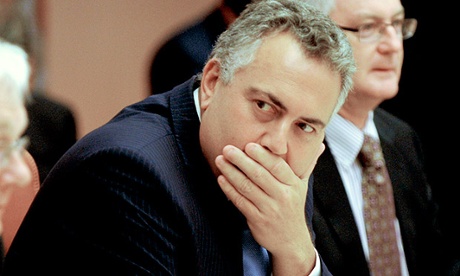
Joe Hockey Joe Hockey says the audit report is 'not the budget'. Photograph: Alan Porritt/AAP

The Coalition is bracing for a significant political backlash as it refuses to rule out most of the highly contentious recommendations in the Commission of Audit report despite the fears being raised among pensioners, students, low-income families, disabled people, the sick and public servants.

And the head of the commission, Business Council of Australia president Tony Shepherd, has questioned the rationale for the government’s plan to impose an immediate tax hike for higher income earners to “share” the budget pain – saying there was not really a short-term “budget emergency” but rather a serious longer term structural problem with the nation’s finances.

Shepherd said the audit commission had deliberately avoided big immediate spending cuts that could hurt consumer and business confidence and “sudden policy shocks” that would make it harder to convince the community of the need for fundamental change.

The government has all but confirmed it is considering a temporary tax increase for higher earners, despite deep concerns in its own ranks and the fact that a tax increase would constitute a clear broken promise.

“There is a need for an immediate special effort … to strengthen our starting position as we move to reduce the deficit ... so the decisions we are considering is how to make sure the immediate special effort is spread fairly across the whole community,” the finance minister, Mathias Cormann, said.

Shepherd said the government was “saying they need to act now to get out of deficit quickly and to get the money to invest in infrastructure to speed the economic recovery.

“It’s a political judgment really, and I agree with the need for infrastructure spending, but economically you have to be careful you don’t hit confidence.”

A longer term way to spread the budget “pain” to the wealthy would be to wind back some of the $30bn in superannuation concession paid each year. The commission said that as a tax measure this was beyond its brief to look at government spending, but added “many superannuation tax concessions disproportionately benefit higher income earners, when compared to taxation at marginal tax rates under the progressive income tax system” and suggested they be examined by the government’s tax review.

The treasurer, Joe Hockey, insisted the report was “not the budget” and not all of the commission’s recommended cuts would be adopted, and many would be referred off to other government reviews of taxation and federal-state relations. But he refused to rule out any recommendations other than the suggestion that the government reconsider its long term goal for increasing defence spending and the recommendation to include the full value of the family home in the means test for the aged pension. In an interview on the ABC’s 7.30, Cormann would not rule out the commission’s recommendation that high income earners should be forced to take out private health insurance for basic medical services – a step that would effectively end Australia’s system of universal health care.

Meanwhile, the public service union warned the commission was under-estimating its calculation that its recommendations for abolishing and merging government agencies would cost 15,000 jobs, saying the real figure would be closer to 25,000.

Disability groups reacted angrily to the call for a slower roll out of the national disability insurance scheme and the Australian Council of Social Service said the report’s recommendations threatened Australia’s social safety net and failed the “fairness test”.

“It is fair and reasonable to expect that governments to ensure that when any of us get sick we can get treatment; that when we lose our job, there’s a safety net to see us through the tough times; and that all children get a chance to a decent education,” ACOSS chief Cassandra Goldie said.

“These reasonable expectations are under challenge by proposals to create a two-tiered system in health and education that will result in decent services for those who can afford to pay and a second rate system for those who can’t. For this reason we reject the proposal of a GP co-payment that will severely impact people on the lowest incomes and those with chronic illness. It would lead to reduced visits to doctors and greater pressure on the hospital system.”

The Labor party and the Greens seized on the report to accuse the government of hitting the poor and cutting services for working families.

The Greens say the commission’s terms of reference were “rigged” to get the recommendations the government wanted, that it was a report “by business, for business”. The Greens have called Shepherd before a Senate inquiry Friday morning to “explain himself”.

And Clive Palmer said his Palmer United Party would not support any of the suggested changes to the aged pension.

Hockey said it was “kind of ridiculous” for the government to be required to keep every election promise when it had inherited a budget which Labor had falsely promised would return to surplus.

“All this talk about broken promises, of course we will endeavour to keep our promises … but please, this idea that everything we said is going to be held against us ... given what has moved on us is kind of ridiculous,” he said.

And he said the report proved that there was an urgent task to repair the budget and avoid deficits and increasing national debt into the next decade.

He said the Coalition had "inherited a mess", with $123bn in projected deficits over four years.

"The challenge now is to get on with the job of fixing the mess, and we will," he said.

"...The fact is that unless structural reform is undertaken Australians will have a lesser quality of life in the future than they have today,’’ he said.

“I have no doubt that there'll be many issues that are highly contentious and somewhat difficult for various stakeholders and some in the community to accept. But there is an overwhelming challenge here and that is to ensure that the budget is structurally fit for the future.”

Coalition braces for angry backlash from potential cutback victims | World news | theguardian.com

A recipe for a poorer, nastier and more brutish Australia

 Ben Eltham

Ben Eltham theguardian.com, Thursday 1 May 2014

The prescriptions advocated by the Audit are stock-standard 1980s-era neoliberalism: privatise government assets, abolish government agencies, charge citizens more

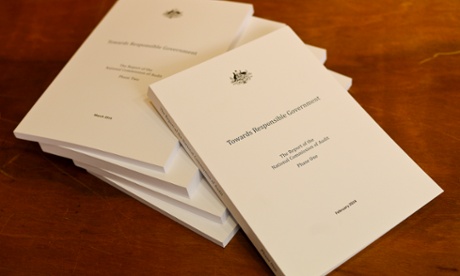
The report of the Commission of Audit, which weighs five kilos. The report of the Commission of Audit, which weighs five kilos. Photograph: Lukas Koch/AAP

We always knew the Commission of Audit would produce a small government, low spending, neoliberal report.

Why? Because that’s what the government set it up to do.

The Commission of Audit was announced as a supposedly independent body. But the people doing the auditing are mostly rusted-on, hardline conservatives. Tony Shepherd, a former chairman of Transfield, is also the former boss of big business lobby group, the Business Council of Australia. Peter Boxall is a former chief of staff to Peter Costello. Howard government minister Amanda Vanstone is there too. This is a political body, set up to do a very political job.

The giveaway is there in black and white, in the Audit’s terms of reference. These give it “a broad remit to examine the scope for efficiency and productivity improvements across all areas of Commonwealth expenditure, and to make recommendations to achieve savings sufficient to deliver a surplus of 1% of GDP prior to 2023-24.” Top of the list: to “ensure taxpayers are receiving value-for-money from each dollar spent” and “eliminate wasteful spending.”

Framing an exercise like this as delivering value for money and cutting waste ensures that the debate is all about government spending. There is no acknowledgement that the real cause of the current deficit is a shortfall in revenues, not a blow-out in expenditures. Nor is there any mention of the fact that the Commonwealth’s spending is low by OECD standards, and in fact is broadly consistent with spending levels in the later years of the Howard government.

The Audit ignores all this. “We have spent beyond our means for too long,” it complains, bemoaning the “sixth consecutive budget deficit.”

It’s as though that minor event known as the global financial crisis never happened. This is truly the “autistic” economics that a group of French university students protested about in June 2000.

The prescriptions advocated by the Audit are stock-standard 1980s-era neoliberalism. Privatise government assets. Cut red tape. Abolish or amalgamate government agencies. Charge citizens more for government services, like visits to the doctor. Slash government benefits, especially for the most vulnerable. Make students pay more for their education. Reduce foreign aid. Abolish national protections, like a national minimum wage. Halt Commonwealth support for the homeless.

This is a recipe for a poorer, nastier and more brutish Australia. If implemented, it would mark the beginning of the end of the Australian fair go.

By far the most radical proposal is to junk a century of federal-state relations and return huge swathes of the Commonwealth’s functions to the states. This is cloud cuckoo stuff. The states are struggling to fund the services and functions they currently provide. It is absurd to believe a tiny state like Tasmania can provide the kind of advanced public services that all citizens demand. Australians should not be condemned to lower standards of living and poorer public services just because they live in a small state.

The idea to give the states a 10% income tax tells you all you need to know. Despite a mania for reducing complexity, the Commission of Audit wants to cut federal tax rates, only to increase them again with an extra income tax for the states. At the same time as it complains about duplication, the Audit wants to take single, federal programs and devolve them to eight separate states and territories. Go figure.

We don’t need to ask ourselves what Australia would look like if this radical plan were implemented. Just look across the Pacific. The United States has a small federal government as a share of GDP, and devolves many public services to its states. It has a vestigial or non-existent social safety net. It has low taxes and many social services are privatised. In other words, it is exactly the sort of country the Commission of Audit would like to see Australia become.

How is the small government, market-is-best ideology working for the US? America has endemic intergenerational poverty, massive inequality, crumbling infrastructure and lower life expectancy that Australia. America’s public finances are much worse than Australia’s, with huge deficits and a growing public debt. Its economy has grown much more slowly than Australia’s over the past decade; its middle classes have actually shrunk since the mid-1970s.

You’d have to be a certain sort of person to want this future for Australia. You’d have to be driven by ideology, not evidence. You’d have to have internalised a certain type of economic theory that tells you that markets are always better, and that governments are always worse. You’d have no fear of cuts to government benefits or services, because your large personal fortune ensures you can always pay the best for everything.

Needless to say, no one who worked on this Audit was a homeless person, a worker on minimum wage, or someone with a permanent disability. Instead, an unrepresentative and partisan group has used shoddy arithmetic and junk economics in an attempt to destroy a century of Australian social welfare.

Commission of Audit: a recipe for a poorer, nastier and more brutish Australia | Ben Eltham | Comment is free | theguardian.com

Pendakian Gunung Prau

Assalamu’alaikum...
Oke sobat, stelah sekian lama ane gak posting, kali ini ane akan share pengalaman ane saat mendaki di G. Prau/prahu, entah yg bener mana tuh, “prau atau prahu”..  udah lah yg penting sobat uda ngerti mksud ane,


Mendaki gunung merupakan salah satu bukti bahwa kita masih mempunyai rasa cinta terhadap Alam, kenapa...? karena yang namanya mendaki gunung, kita tidak hanya ditunjukan dengan pemandangan yang indah, tetapi kita diberi pelajaran tentang kehidupan, di gunung kita memerlukan yang namanya hidup bersosial/berkelompok, karena sedikit kemungkinan kita tidak akan berhasil mendaki seorang diri, di gunung kita akan mengerti akan artinya perjuangan, kekompakan, kerjasama, kepercayaan dan keikhlasan,
Yup, langsung saja cek it dot,, pasti sobat pada penasaran dengan yang namanya gunung prau, G. Prau merupakan gunung yang terdapat di Dataran Tinggi Dieng tepat diperbatasan kabupaten Kendal dengan Kabupaten Wonosobo, Jawa Tengah, gunung ini memiliki ketinggian 2.565 mdpl, dan kenapa disebut gunung prau, dikarenakan memang puncak gunung ini tidak berbentuk kerucut spt gunung lainnya, 
Pada saat itu, ane berangkat bersama tim PA Smk ane, yaitu Rismapala (Remaja Islam Pecinta Alam) SMK Muhammadiyah Pekalongan, dan berkumpul di Politeknik Batik Pusmanu Pekalongan, ane kira ane telat, karena disuruh kumpul jam 7 tepat, sedangkan ane sampe disitu pukul 7.30, tapi kebiasaan WIB(Waktu InsyaAllah Berubah) sudah menjadi tradisi di Indonesia, hehe... dan akhirnya ane gak telat, setelah sampe dipoliteknik tiba saatnya pembagian kelompok dan pembagian kaos Panti Asuhan kegiatan pendakian yang kembar semua, 
 narsis dulu sebelum berangkat

Setelah sekian lama menunggu, kami berangkat menuju basecamp wonosobo dari pekalongan pukul 09.00 dan sampai di basecamp sekitar pukul 13.30, dibasecamp kami istirahat sejenak setelah hujan-hujanan di truck, dan melaksanan shalat ashar serta men-Jamak qashar, karena kemungkinan diatas sulit untuk melaksanakan shalat maghrib, setelah itu kami kembali mempersiapkan peralatan untuk tracking ke puncak, dan mulailah goes ke puncak pukul 16.00,
 berdoa sebelum berangkat

setelah beberapa jam perjalanan, kami belum samapai dipuncak sudah diguyur hujan lebat, akhirnya kami memutuskan untuk berhenti sejenak karena ada intruksi dari panitia bahwa dipuncak rawan petir, bahkan ada panitia yang menyuruh kami untuk turun kembali, tapi sangat sayang sekali, karena puncak tinggal sedikit lagi, dan kamipun memutuskan untuk membuat tempat untuk berteduh seadanya menggunakan matras, yang tepenting kami bergerombol dan berpelukan karena sangat dingin sekali, setelah -+ 2jam menunggu hujan reda, kami melanjutkan perjalanan kepuncak pukul 19.30 dan berbagai rintangan kami hadapi, ada yang terpeleset, keseleo, kram, dll,,
Akhirnya kami sampai di puncak pukul 21.00, dan itu menurut kami waktu yang masih terlalu sore, karena kami takut lamanya diatas puncak bisa menyebabkan hipotermia, setelah sampai dipuncak, kami bergegas untuk mendirikan tenda dan setelah tenda berdiri kami langsung ganti pakaian dan makan snack seadanya, setalah perut sudah cukup terisi, kami mempersiapkan diri untuk tidur dengan memakai celana pendek dan sarung serta jaket, huuuuhhhhhh bbbrrrrrrrrrrrrr very coooollll....
Tak terasa hari sudah pagi, dan jam menunjukan pukul 04.30, di puncak jam segitu sang fajar sudah hampir terbit, dan kamipun bergegas untuk bangun dan menikmati sun rise dipuncak G.prau dan narsis dibukit teletubis, dan subhanallah, sungguh luar biasa Alam ciptaan Tuhan ini, kita terasa sangat kecil untuk bisa berdiri di bumi ini,
Setelah puas kami mengambil gambar untuk kenang-kenangan, kami bersiap-siap untuk turun pada pukul 09.00, dan sampai di basecamp sekitar pukul 11.00, dibasecamp kami istirahat dan bersyukur karena masih diberi kesempatan untuk bisa menikmati indahnya Dunia ini,,
Dan sekian artikel tracking ane, kurang lebihnya seperti itu, dan tunggu artikel ane yang lainnya ya...
Thanks... wassalamu’alaikum...